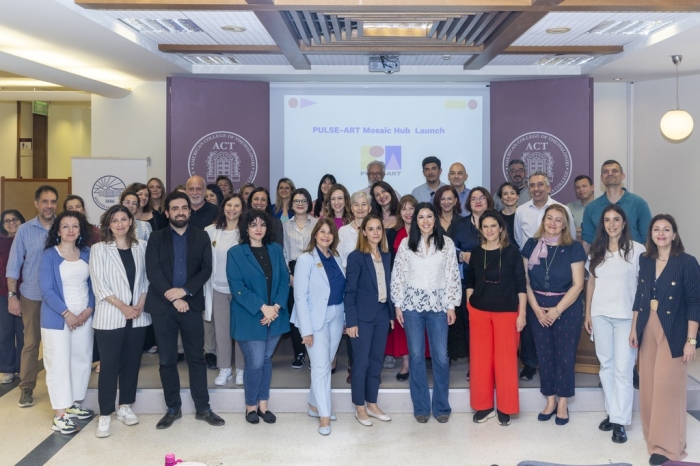
On May 22, 2025, 40 participants from diverse backgrounds gathered at the Bissell Library of the ACT (American College of Thessaloniki) to join the launch of the MOSAIC HUB in Greece, part of the Horizon Europe-funded PULSE-ART project. Educators, artists, policymakers, and representatives of cultural institutions took part in a creative brainstorming session and exchange of ideas and good practices, all driven by the shared goal of embedding Cultural Awareness and Expression (CAE) into the educational landscape. Anatolia College, through the Anna Papageorgiou STEM Center and ACT (American College of Thessaloniki), is participating in the pioneering European program PULSE-ART, which aims to highlight the power of art as a tool for educational and cultural development.
This interactive co-creation event sparked dialogue around the challenges and opportunities for incorporating CAE into Greece’s educational system. Participants explored how art, culture, and heritage can become powerful tools for inclusive education and civic engagement.
The ideas and insights generated during this session will be gathered, analyzed, and correlated with results from other MOSAIC HUB events happening in partner countries across Europe and Morocco. Together, they will contribute to the development of a comprehensive Competency Framework, professional development opportunities for teachers, and self-reflection tools for assessing CAE integration.
This session is part of PULSE-ART’s broader mission: to showcase the impact of arts in fostering Cultural Awareness and Expression, and to build a vibrant network of collaboration and innovation at the intersection of art, education, and cultural diversity.
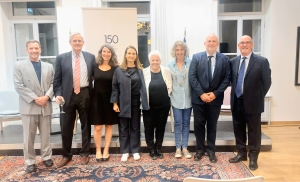
Dr. Iro Koliakou, Head of STEAM programs, Anatolia College, with Dr. Maria Kyriakidou, Chair, Division of Humanities and Social Sciences, ΑCT.
For more information about PULSE-ART and its ongoing work across seven countries, visit pulseartproject.eu.
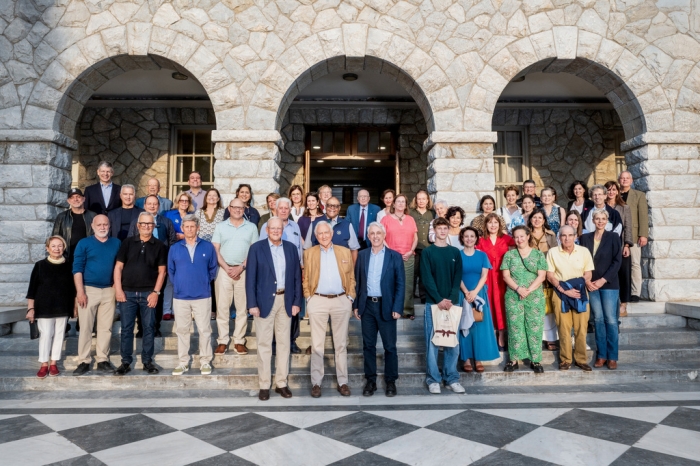
William McGrew and Richard Jackson were two emblematic Presidents of Anatolia College, whose leadership played a defining role in the institution's progress and growth. In recognition of their contributions, the Board of Trustees has decided to honor their legacy and memory by naming two key spaces on campus:
The Anatolia College Indoor Gym has been named William McGrew Sports Center
Tsipos Hall has been renamed Jackson Hall
The ceremonies took place during the Board of Trustees meeting in Thessaloniki on May 29 and 30, 2025.
William McGrew Sports Center
William McGrew was the ninth President of Anatolia College and its longest-serving leader, holding office for 25 consecutive years (1974–1999), later also serving as President of the American Farm School (2005–2009). Before that, he served in the US Foreign Service in Greece, Turkey, and Cyprus. During his presidency at Anatolia College, he faced numerous political and economic challenges, which he met with unwavering resolve and effectiveness. A defining moment of his leadership was the establishment of higher education within the institution through the founding of ACT (formerly SBALA).
Holding a PhD in Greek and Modern European History, he was the author of Land and Revolution in Modern Greece, 1800–1881 (1985). His decade-long research culminated in the publication of Educating across Cultures: Anatolia College in Turkey and Greece (Rowman & Littlefield, 2015), a seminal account of Anatolia College's journey from its beginnings in Boston to the present day. The book was translated into Greek and published in 2019 as Γεφυρώνοντας Πολιτισμούς με την Εκπαίδευση – Το Κολλέγιο Ανατόλια στην Τουρκία και στην Ελλάδα (Kapon Editions).
"Bill was among the last of the special breed of strong, imperious educational leaders who led the best of the American Boarding schools in the mid-20th century. He was in charge and had a special understanding of the educational needs of students in a changing social and political landscape," said the President of the Board of Trustees, Albert "Chip" Elfner, III.
The decision to name the Anatolia College Indoor Gym after him was also inspired by his love for athletics and basketball. Students, alumni, and staff fondly remember Bill McGrew playing basketball alongside them on both the indoor and outdoor courts. Among them was the current President of Anatolia College, Dr. Panos Vlachos, then a professor at ACT.
"Bill McGrew believed deeply in this institution, its mission, and its people. He led with principle, vision, and determination," said Dr. Vlachos. "Bill once told me, 'I got to know you better on the basketball court.' He was right. Sports, like education, demand discipline, teamwork, and perseverance—and they reveal one's character. That's why naming this sports center in his honor is a most fitting tribute."
Dr. Vlachos highlighted the major transformations McGrew led during his remarkable 25-year tenure: coeducation at the secondary school level, the launch of the IBDP program, and the founding of ACT—"planting the seeds of a dynamic higher education division that flourished, especially after he oversaw its accreditation in the U.S. That was a defining moment of strategic foresight," he noted.
"Our first centennial allowed Bill to honor the past while literally and figuratively building the future—with the construction of the Eleftheriades Library and Constantinidis Hall, then aptly called the New Building. All of this amounts to more than just a legacy—it is a solid foundation upon which we continue to build."
Richard Jackson Hall
Richard L. Jackson, a Princeton University graduate, assumed the presidency of Anatolia College in 1999, succeeding William McGrew, and served for a decade as its tenth President. Under his leadership, the College achieved several significant milestones, including:
The founding of Anatolia Elementary School at the former "Rigas Feraios" campus (2003)
The construction of the Bissell Library at ACT (2002) and the expansion of its academic programs
The construction of the Alumni soccer and track field (2005)
Under Jackson's leadership, ACT began offering U.S.-accredited graduate programs, having received accreditation from the New England Association of Schools and Colleges (NEASC), now known as the New England Commission of Higher Education (NECHE). ACT's undergraduate programs were also granted European recognition—initially through the University of Wales and later through the UK's Open University (OU).
«By naming this space today, Jackson Hall, we commemorate 11 years of your service to Anatolia, and we acknowledge a permanent place for your name and memory to be recognized by Anatolians now and for generations to come," said President of the Board of Trustees Albert "Chip" Elfner, III, during the ceremony, which Jackson attended.
"Richard Jackson was a remarkable leader who guided this institution through a decade of transformation," emphasized Anatolia College President Dr. Panos Vlachos. "During his tenure from 1999 to 2009, Jackson was instrumental in spearheading a bold development phase that laid the foundations for many of the strengths we build upon today".
"Perhaps Dick Jackson's most visionary step was to seek partnership with Northeastern University's NUin Program, which continues to bring study abroad students to our campus while contributing significantly to our institution's funding. Today, we mark our gratitude in a lasting way," added Dr. Vlachos, thanking Jackson for his leadership, dedication, and belief in Anatolia.
"It's moving to be back on the Anatolia campus and to see my name on this building," said Richard Jackson from the podium.
"I am truly grateful to George Bissell and Stavros Constantinidis for their extremely wise consul. They were truly the adults in the room. And thanks, of course, to the superb board (of Trustees) that is a model of what the governments should be".
Jackson expressed heartfelt gratitude for the honor of having Tsipos Hall renamed in his honor and thanked all those who contributed to the school's progress. "What all of you together have done in growing this campus, there's no other word for it but spectacular." He also recalled moments from his presidency, especially the early days. "I remember my first day as President at Anatolia. I've been a diplomat for 34 years; I didn't know what it was to be a president".
He highlighted the new conditions emerging in global education and expressed his belief that this is a unique opportunity for Anatolia College to attract more Greek and international students. "I have every reason to feel that the future of this College for the next century to come is very bright. The best is yet to come. I am, as many of you know, returning to the US in July, but I will be following this campus very closely from there, and I will be cheering. I would like to thank all of you for your efforts in improving the school and for your ongoing support”.
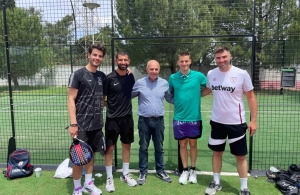
On Friday, May 30, 2025, Greek soccer star Giannis Konstantelias visited ACT and joined Sparrowhawks Soccer Coach Vasilis Toloudis and friends for a friendly match on the school’s new padel court.
Konstantelias, who plays as a midfielder for PAOK FC and the Greek National Football Team, brought his signature energy and spirit to the game, enjoying the new addition to ACT’s athletic facilities.
The ACT Padel Court, inaugurated in April 2025, enhances the range of sports and recreational activities offered to students.
For the second time this month, the Dukakis Center at ACT and the Demos Center at ACG teamed up to co-host a roundtable session on the theme “The World in 2025.” The event, an integral part of the Demos Center’s “Voices of Democracy” series, took place on May 28, 2025, at the Demos Center’s Plaka facility in downtown Athens.
An all-star panel addressed an alert and engaged audience of students, expats, and local well-wishers for over two hours, adroitly moderated by the journalist Katerina Bakoyianni of Alter Ego Media. The architect of the evening’s proceedings, Mary Cardaras, Director of the Demos Center, invited a former diplomat, Brady Kiesling, a veteran journalist, Nikos Konstandaras of Kathimerini, an educator, ACG’s Effie Fokas, a human rights activist, and finally Gelly Aroni, Head of the Unit for Integration in the Special Secretariat for the Protection of Unaccompanied Minors in the Ministry of Migration and Asylum, to share their perspective on the state of the world halfway through 2025.
The topics explored had to do with challenges to democratic systems worldwide, the state of human rights currently, the difficulties faced by policy-makers and senior civil servants in crafting and carrying out good policy, and finally the role and responsibility of the press in covering -- or not -- the long-term origins of populist movements in Europe and North America.
What is the mood of the moment? Are we facing possible annihilation owing to irresponsible policy choices? Or is the native optimism of the youth cohort many of those present partake sufficient to override any temporary pessimism? What of those pockets of society which resist reform and the clear will of the people, the vox populi? How do we best explain the continued appeal of populist political messaging?
Brady Kiesling evoked the opening lines of the Declaration of Independence in his intervention, lamenting that there no longer seems to be a “decent respect” to the opinions of humanity in how we behave toward one another, all the while noting that the legitimacy of a political system canot be bought or sold on the cheap. Effie Fokas urged the students in the audience not to lose heart, it being the role of youth in society to inspire hope. More broadly, Gelly Aroni challenged all present to look at themselves closely as they make their political choices, to understand where they stand in the electorate. Nikos Konstandaras closed the evening’s deliberation by inviting everyone to tell stories, to tell their story.
A lively reception followed the formal discussion.
The two May round tables (the first having taken place in Thessaloniki on May 14) brought to a rousing conclusion the 25th anniversary season of public service initiatives at the Dukakis Center. The Dukakis Center and the Demos Center will plan to co-host one or more events in similar fashion during the 2025-26 year, as the American College of Greece celebrates the 150th anniversary of its founding.
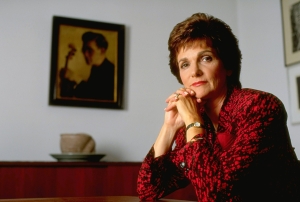
A loving woman, wife, and mother, with a true desire for human rights activism and social work,who showed the world how vulnerability is not a sign of weakness.
A person’s legacy is measured by the lives they touch, the values they uphold, and the impact they leave behind. Katharine “Kitty” Dukakis, wife of former Massachusetts governor and 1988 Democratic Presidential candidate Michael Dukakis, died on March 21, 2025, at the age of 88, leaving a legacy that should be cherished.
Committed to lifelong learning, Kitty pursued her education at Pennsylvania State University before earning a Bachelor of Arts in Education from Lesley College. During this time, she met Michael Dukakis. They married in 1963, the same year she earned her Bachelor's degree in Education, and later had two daughters, Andrea and Kara, whom they raised along with her son John from a previous marriage. She obtained a Master of Science in Broadcast and Film from Boston University’s School of Communications in 1982, followed by a Master’s in Social Work from the Boston University School of Social Work in 1992. Her dedication to education and public service was reflected not only in her academic achievements but also in her contributions to the community.
In 1976, a year after Michael Dukakis became governor of Massachusetts, Kitty, who was Jewish and was subjected to anti-semitism during her childhood, returned from her first visit to Israel “converted” by a new connection to Judaism. She wrote, “I hate to sound corny, but I had a spiritual awakening”. Following her visit, a subject most important to her was the Holocaust and its teaching. She engaged with Brookline educators who were in the process of establishing "Facing History and Ourselves," a now-national education program dedicated to teaching about the Holocaust and other atrocities, including the Armenian genocide. Additionally, in 1978, President Carter appointed her to the first President’s Commission on the Holocaust, which sought to build a Holocaust memorial museum in Washington, D.C. A decade later, when that panel was replaced by the United States Holocaust Memorial Council, she was appointed to the council by President George H.W. Bush, reflecting her commitment to Holocaust education and awareness.
Beyond being a leading voice in raising awareness of the Holocaust and the Armenian genocide, Kitty Dukakis was a steadfast advocate for the underdog, devoting herself to projects involving the homeless and political refugees. In 1979, she was appointed to the board of directors of the Refugee Policy Group and later joined Refugees International, working extensively on issues related to displacement and human rights. She played a pivotal role in addressing the Cambodian refugee crisis, organizing a mission to Thailand in 1981 that secured the release of 250 unaccompanied orphaned Cambodian minors, many of whom resettled in Massachusetts. Her commitment extended further in 1985 when she undertook a fact-finding tour of refugee camps in Thailand, leading to the establishment of the Refugees International/Cambodian Crisis Fund to support Southeast Asian refugees with family ties in the United States. Governor Dukakis stated that his wife had always been empathetic towards the powerless and had stated “She was a born social worker” in a 2016 interview. Her advocacy was marked by “honesty, compassion, and strength to public life,” and “Her legacy is one of service, resilience, and truth-telling” said Maria Ivanova, director of Northeastern University’s Policy School, in a statement.
Her unwavering commitment to openness and advocacy was equally evident in her work on mental health and addiction recovery, where she fearlessly shared her personal experiences to break stigma and support others in their recovery. Her struggles with substance use began in 1956 when she developed a dependence on amphetamines, a habit that persisted for 26 years. During her husband’s 1988 presidential campaign, she publicly disclosed her past addiction to diet pills and later spoke candidly about her battle with alcoholism. Following her husband's electoral defeat, she faced increased struggles with alcohol, prompting her to seek treatment through a 60-day program, though she later experienced a relapse. She chronicled these experiences in her 1991 memoir, Now You Know, where she explored the deeper-seated affliction of depression that contributed to her addiction. Recognizing that conventional treatments were ineffective in managing her depression, Dukakis turned to electroconvulsive therapy (ECT) in 2001. She became a strong advocate for the benefits of its treatment, allowing producers from “60 Minutes” to document one of her sessions and later co-authoring Shock: The Healing Power of Electroconvulsive Therapy (2006). The treatment, she wrote, "opened a new reality for me… I used to deny when a depressive episode was coming on, to myself and others. I know how much it would hurt, how long the darkness would last. Now I know there is something that will work and work quickly. It takes away the anticipation and the fear.”
Beyond her personal journey, Dukakis worked to support others facing similar challenges. She and her husband hosted mental health support groups in their home, and she led a five-week community discussion group on spirituality and mental health with social worker Hadassah Margolis at Congregation Kehillath Israel. In recognition of her advocacy, the Lemuel Shattuck Hospital in Jamaica Plain, Massachusetts, named its addiction treatment center in her honor. Through her openness and activism, Dukakis significantly contributed to destigmatizing addiction and mental health treatment, leaving a lasting impact on public discourse and policy.
In a statement after her passing, she was described by her family as “loving, feisty, and fun, and had a keen sensitivity to people from all walks of life... She lived a full life fighting to make the world a better place and sharing her vulnerabilities to help others face theirs”.
Reflecting on her life, I am not only struck by her contributions but also by what she represents for my generation, especially for young women aspiring to enter the political and public sphere. At 22, I look at women like her with admiration and gratitude, recognizing the challenge she faced and the legacy she had left behind for those of us who seek to make an impact in the world. Arguably, Kitty Dukakis belonged to a generation of women who often had to navigate political and social landscapes that did not willingly welcome their voices. Looking back at that time, one rarely saw women next to political figures voice themselves the way Kitty did. Yet, she was the exception that forged her own path, not solely as the wife of a presidential candidate and governor, but as a fierce advocate for human rights, social work, and most exceptionally, the destigmatization of addiction and mental health. I think that even today, in a world where young women in leadership still face scrutiny and unrealistic expectations, Kitty’s transparency and resilience are empowering, and can be taken as a lesson demonstrating how true strength does not derive from the absence of vulnerability, but rather from the courage to confront it, own it, and use it to help the people around you. As a result, through challenging norms and expectations, Kitty expanded the space for women of new generations that might follow. I truly believe that Kitty Dukakis’s sense of responsibility toward humanity, which she demonstrated in many different ways throughout her life, will inspire young women to be compassionate, bold, and perseverant in the pursuit of their passions and ambitions.
In memory of Kitty Dukakis, whose legacy of compassion and service will never be forgotten. Jana Chapovska (ACT Class of 2025)
Our fans were chuffed. Jaws dropped around the room. A lone, unnamed journalist who had stayed to the bitter end triumphantly called the scene before him an unqualified success -- "Με επιτυχία ολοκληρώθηκε!” he would write in his midnight lede.
The Dukakis Center at ACT thus brought its Silver Jubilee celebrations to a rousing conclusion this past Wednesday evening, May 14, in a star-studded round table session on the state of world politics halfway into 2025.
A SRO audience at Olympias Hall in the Vellidis Convention Center was treated to a veritable masterclass in international relations in the twenty first century. Co-hosted by the Dukakis Center and the Demos Center at the American College of Greece, and c0-moderated by David WIsner, Professor of International Relations at ACT and Executive Director of the Dukakis Center, and Nektaria Stamouli of Kathimerini and Politico Europe, a veritable who’s who of international relations experts from throughout Greece provided the analysis for well over two hours, to an audience whose attention never waned.
From the off it was evident that the quality of the discourse would be uniformly high -- as was acknowledged after hours by the participants themselves. One by one the featured panelists opined and offered their interpretations on how best to understand events unfolding almost in real time. Constantinos Filis, Professor of International Relations at the American College of Greece and Director of the Institute of Global Affairs, opened the discussion, followed by Maria Gavouneli, Professor of Law at the University of Athens and Director of ELIAMEP, Peter Gries, Professor of Chinese Politics, and Lee Kai Hung Chair and founding Director, Manchester China Institute, and Spyros Litsas, Professor of International Relations Theory, University of Macedonia.
How should one understand the leadership style and policy preferences of the Trump administration? How should Europe and the EU respond? How is one to make sense of developments in Russia, China, the Middle East, and elsewhere? What kind of world order is emerging -- bipolar, multipolar, multi-centric, to use Professor Filis’ term? Is the post-1945 liberal international order in its final death throes? A few themes were underscored repeatedly: trust in American leadership had been lost; Donald Trump’s motives and guiding principles are still open to interpretation; a recalibration, if not realigning, of the international order was of the essence.
Not to be outdone, several members of the audience chimed in, asking probing questions of the panelists on such topics as different scenarios facing the EU and NATO, the ideological preferences of the American electorate, the specter of Greek-Russian relations, and the potential impact of AI and technological innovation in global politics. No one had the last word, fittingly, perhaps, given the contentious nature of the subject at hand and the multiform scholarly orientation of the panelists, who approached the topic from the perspectives of international diplomacy, international law, political psychology, and international relations theory,
Dr. Wisner left it to those present to attend the second “Voices of Democracy” round table on the same subject, to take place under the combined aegis of the Demos Center and the Dukakis Center in Athens on Wednesday, May 28.
On the eve of this encore appearance, it is worthwhile to recap what has been an extraordinary eighteen-month celebration, which began in late 2023 with a landmark poll and conference on the youth vote in the 2023 Greek parliamentary elections. In March and again in September of the following year Dukakis Center contributed to registering a record number of overseas Americans to vote, and then braved gale force winds and torrential rain to celebrate the year of global elections that was 2024. (Dukakis Center Director Wisner delivered a prescient presentation at Aristotle University Law School on the state of American media and democracy, and appeared occasionally on local television to assess the state of American politics.)
Throughout the 2024-25 school year the Center hosted and underwrote public events for the benefit of ACT and public university students on and off campus, including the annual Kavala Summer School in August 2024, the Thrace Negotiation Tournament in March 2025, and, remotely, the annual Civic Learning Week, also in March. James Quirk and Sarah Snyder visited Thessaloniki from ACT’s study abroad partner American University, and Dr. Wisner hosted a fireside chat with Clay Shirky, Vice Provost for AI and Technology in Education at New York University at Beyond 2025 in Athens -- one fan later wrote on social media that the Dukakis Center session “was one of the standout moments of the conference.” A pair of senior interns paid tribute, finally, to former Anatolia College President Bill McGrew and to the late Kitty Dukakis.
Planning is already underway for the 2025-26 academic year. The Center’s next major initiative will be a citizen-centric celebration ahead of the semiquincentennial of the signing of the Declaration of Independence, which actually launched during the Spring I 2025 semester. The project will entail recruiting teams of two or three study abroad students apiece to interact with inhabitants of Thessaloniki, to understand what they think about this important moment in American history. The Center will also host an event comparing the Greek Revolution of 1821 with the American Revolution of 1776.
The Dukakis Center will also hope to participate at next year's Beyond, and to host a small conference in Thessaloniki on Civic AI during the fall semester. A final year-long project will examine how American expats in Greece might fill the gap should the US Consulate General in Thessaloniki be downsized or even shuttered.
Thessaloniki International Book Fair returns this year from May 8 to May 11, 2025, at the facilities of TIF Helexpo, and we are thrilled to see our beloved alumni and teachers presenting their books or participating as speakers.
Below, you will find the schedule by day, along with the location of each speaker:
Thursday, May 8, 2025
POETRY BOX HALL – PAVILION 14 | 20:00 – 21:00 Ioannis Kantartzis ’91 presents his book "Invest Now. Thank Me Later."
Friday, May 9, 2025
LEXIS HALL – PAVILION 12 | 13:00 – 14:00 Anatolia HS professor Marios Kyparissis Moros and Iliana Magra ’12 present "Jacarandas" by Foivos Economides.
LEXIS HALL – PAVILION 12 | 14:00 – 15:00 Aigli Brouskou, Anthropology professor at ACT, participates in the presentation of Panagiotis Gouberis' book "Dad, Do You Miss Me? Stories Inspired by Parental Alienation."
LOGOS HALL – PAVILION 12 | 17:00 – 18:00 Anatolia HS professor and author Leon A. Nar participates in the presentation of Zoe Bozenberg's book "The Diagonal of the Square."
M. THEODORAKIS HALL – PAVILION 13 | 18:00 – 19:00 Aigli Brouskou participates in the presentation of Rika Benveniste's book "Louna. Essai de biographie historique."
LEXIS HALL – PAVILION 12 | 19:00 – 20:00 "70 Years Konstantinidis – 21 Years TIBF. Honoring the Fair and the Book." Speakers: Evripidis Konstantinidis, ACT ’94 graduate and owner of the historic bookstore in Thessaloniki, and Leon A. Nar.
LOGOS HALL – PAVILION 12 | 19:00 – 20:00 Author and collector Yiannis Megas ’64 speaks at the presentation of Agis Pergantis' book "Once Upon a Time, There Was a City: My Neighborhood and Other Stories."
Saturday, May 10, 2025
COSMOS HALL – PAVILION 14 | 10:00 – 11:00 Poet Chloe Koutsoubeli ’80 presents "Paradise Birds" by Yiannis Paschos.
PHILOLOGICAL CAFÉ HALL – PAVILION 12 | 12:00 – 13:00
TRIBUTE: “Honoring author Periklis Sfyridis for his lifetime work.”. The Thessaloniki Society of Writers honors author, critic, publisher, and art collector Periklis Sfyridis (Class of '52) for his body of work and for his contribution and service to the city of Thessaloniki.
COSMOS HALL – PAVILION 14 | 13:00 – 14:00 AUTH professor Venetia Apostolidou ’79 and Leon Nar present Eleni Beze's book "New Life: Greek Jews after the Shoah. History, Memory, Identity (1944-1955)."
POETRY BOX HALL – PAVILION 14 | 14:00 – 16:00 11th Young Writers Festival – 1st Meeting Petros Gioulekas ’18 participates.
DIALOGOS HALL – PAVILION 15 | 19:00 – 20:00 MOMus Artistic Director Maria Tsantsanoglou ’82 presents Apostolos Vettas' book "Scenes. Notes on the Art and Technique of Scenography."
M. ANAGNOSTAKIS HALL – PAVILION 15 | 21:00 – 22:00 Marios-Kyparissis Moros presents Dimitris Tziovas' book "History, Nation, and Novel in the Post-Dictatorship Era. Trauma, Memory, and Metaphor."
Sunday, May 11, 2025
POETRY BOX HALL – PAVILION 14 | 11:00 – 12:00 "Dogs Bark in Syllables" by Vagelis Evangelios. Among the speakers: Chloe Koutsoubeli ’80.
M. ANAGNOSTAKIS HALL – PAVILION 15 | 12:00 – 13:00 "The Perpetuity of Jewish Trauma through the Books I Can’t Breathe by Luiz Schwarcz and One Hundred Saturdays by Michael Frank." Among the speakers: Leon Nar.
BABEL HALL – PAVILION 14 | 13:00 – 14:00 "Aurelian" by Louis Aragon. Among the speakers: Marios-Kyparissis Moros.
LEXIS HALL – PAVILION 12 | 13:00 – 14:00 "I Have No Oxygen." Among the speakers: Chloe Koutsoubeli ’80.
POETRY BOX HALL – PAVILION 14 | 14:00 – 16:00 11th Young Writers Festival – 2nd Meeting Petros Gioulekas ’18 participates.
LOGOS HALL – PAVILION 12 | 16:00 – 17:00 "Rio Grande" by Christos Hartomatsidis. Among the speakers: Chloe Koutsoubeli ’80.
LEXIS HALL – PAVILION 12 | 17:00 – 18:00 Chloe Koutsoubeli ’80 presents her poetry collection "Post Office Box: Ark."
M. THEODORAKIS HALL – PAVILION 13 | 18:00 – 19:00 Alexandros Vildiridis ’10 presents his poetry collection "AprosDionysos."
On April 22, 2025, ACT Associate Professor of International Relations, Dr. Christos Aliprantis, delivered a lecture at the Elliott School of International Affairs, George Washington University (GWU), titled "Who Governs the Periphery? Rethinking Sovereignty and Security Assistance in Cold War Greece."
The event was organized as part of Dr. Aliprantis' Fulbright Visiting Scholar residency at GWU and was moderated by Associate Professor Harris Mylonas of the GWU Department of Political Science and International Affairs.
The lecture drew a wide and engaged audience, including students, faculty, researchers, and members of the policy and diplomatic communities from both the United States and Greece. The event provided an opportunity for academic dialogue and exchange on issues related to international relations, Cold War history, and Greek foreign affairs.
Dr. Aliprantis' participation in the Fulbright Program reflects ACT’s ongoing commitment to fostering international academic collaboration and scholarly engagement on global issues.
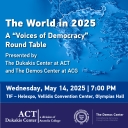
Presented by The Dukakis Center at ACT and The Demos Center at ACG
Wednesday, May 14, 2025 | 7:00–9:00 PM TIF – Helexpo, Vellidis Convention Center, Olympias Hall
Join us for an evening of insight and dialogue as leading experts in international relations, law, and global affairs come together to discuss the key geopolitical and democratic challenges shaping the year ahead.
This round table, part of the Voices of Democracy series and the concluding public event of the Dukakis Center’s 25th anniversary year, brings together distinguished scholars and policy thinkers from Greece and abroad for a thought-provoking conversation on the global landscape of 2025.
Featured Panelists
Constantine Filis, Associate Professor of International Relations, American College of Greece; Director, Institute of Global Affairs
Spyros Litsas, Professor of International Relations Theory, University of Macedonia
Maria Gavouneli, Professor of International Law, National & Kapodistrian University of Athens; Director General, ELIAMEP
Peter Gries, Professor of Chinese Politics, Lee Kai Hung Chair and founding Director, Manchester China Institute
Moderated by
Nektaria Stamouli, Deputy Editor in Chief, Kathimerini English Edition; Eastern Mediterranean Correspondent, Politico Europe
David Wisner, Professor of International Relations, ACT; Executive Director, Dukakis Center for Public Service
This event is open to the public and especially welcomes members of the local expat community, as well as students and faculty from ACT and public universities.
The Dukakis Center at ACT continued its silver jubilee celebrations with a special Dukakis Lecture on the role of expatriate Americans in founding educational institutions in Greece and throughout the Ottoman Empire in the late nineteenth and early twentieth centuries. On Wednesday, April 30, guest speaker Sarah Snyder, Professor of Global Inquiry at American University in Washington, DC, delivered a lecture entitled "Building Educational Institutions Abroad: American Expatriates as Informal Diplomats" at the Emilio Riadis Congress Hall, TIF-Helexpo.
Professor Snyder’s lecture analyzed how expatriate communities throughout the Ottoman and post-Ottoman world founded permanent local institutions that marked their American identity in multiple ways. She profiled nineteenth-century missionaries like Daniel Bliss, who established the Syrian Protestant College, the predecessor of American University of Beirut; and Cyrus Hamlin, who set up Robert College in Istanbul. Snyder’s presentation also showcased the efforts of Americans who established overseas research centers, including Charles McKim, who created the American Academy in Rome; and William Goodwin, the first director of the American School of Classical Studies in Athens. Professor Snyder’s principal point was that the endeavors of American faculty and staff revealed them as novel actors in U.S. foreign relations at the turn of the twentieth century.
Professor Snyder drew her material from her forthcoming book “Unofficial Diplomats, a history of Americans abroad and how they have influenced U.S. foreign policy, to be published by Princeton University Press next year. The book analyzes the impact of expatriates from early American missionaries through the kidnapping of American academics in Lebanon in the 1980s, and reveals a precocious American network throughout the region of schools, churches, clubs, and even cemeteries constructed by missionaries, teachers, businesspeople, and journalists.”
Joining Professor Snyder in a lively round table discussion following the lecture were representatives of three American educational institutions in Greece, Dr. Evi Tramantza, Director of Libraries, Anatolia College; Damiana Koutsomiha, Head Librarian, American Farm School; and Dr. Natalia Vogeikoff-Brogan, Doreen Canaday Spitzer Director of Archives, American School of Classical Studies at Athens.
Evi Tramantza observed that Anatolia College, founded in Merzifon in 1886, closely resembled the schools discussed in Sarah Snyder’s lecture. Dr. Tramantza highlighted the importance of Carl Compton, who began teaching at Anatolia in 1913, relocated to Thessaloniki in 1925, and was named President of Anatolia in 1950. (It should be remembered that Anatolia College was compelled to leave Asia Minor after the signing of the Treaty of Lausanne in 1923.)
Dr. Tramantza and Damiana Koutsomiha, Head Librarian at the American Farm School, emphasized the American values of problem solving, team work, learning by doing, humanitarian service, and community building as being an essential legacy of the founders of their school. Ms Koutsomiha also underscored the long-term impact of American schools overseas like the American Farm School, while also pointing out the uniquely pragmatic concerns of the Farm School’s missionary founders.
Dr. Vogiekoff revealed that while the American School of Classical Studies in Athens has traditionally had as its mission to train Americans classicists and archeologists to appreciate Greece and transmit that knowledge to compatriots in the U.S., the School has more recently begun supporting Greek scholars with no necessary American connections. It might be said also that the School embodies characteristic values of research excellence and professionalism which are often associated with American academic institutions stateside.
David Wisner, Executive Director of the Dukakis Center, reminded the audience in concluding remarks that Anatolia College began a new chapter in its history in 2013 when a Hellene, Dr. Panagiotis Vlachos, was named the school’s twelfth President. This sentiment of reciprocity also animates the Dukakis Center, which not only brings American speakers like Sarah Snyder to Greek audiences in Thessaloniki, but also showcases accomplished Hellenes to American students attending ACT.
Following the event Dr. Wisner enthused, “This was among the most meaningful and moving of any of the events I have organized at the Dukakis Center since its launch over 25 years ago. Congratulations to our local participants, and heartfelt thanks to the American leadership at these institutions for giving our Hellenic colleagues space to absorb and bring to life the “American” values of which Ms Koutsohiha spoke, for instance, and to add through their own personal example what is best in traditional and contemporary Greek culture.”
Earlier in the day on April 30 David Wisner accompanied Professor to the studios of DION TV where she sat for a wide-ranging interview with Dr. Dimitra Makri.
17 Sevenidi St. 55535, Pylaia Thessaloniki, Greece Tel. +30 2310 398398 P.O.Box 21021 Email: This email address is being protected from spambots. You need JavaScript enabled to view it.