Loading...

Career Days 2026 Recap: Workshops, a Packed Fair, and Career-Shaping Dialogue

Three days. Thirty-plus organizations. And a campus that felt noticeably different.

Career Days 2026 ran from March 3 to 5, bringing together students, ACT alumni, and industry professionals for a packed schedule of workshops, a panel discussion, and a two-day career fair that took over Bissell Library. The idea behind it is straightforward: get students and the professional world in the same room and let real conversations happen.

Day 1: Preparation Meets Opportunity

The first day opened with “Ace Your Next Interview,” a hands-on workshop by Entrepreneurship Talks on mastering interviews — how to walk in with confidence, what to say, what to ask, and the small things that set top candidates apart. It was a deliberate choice to start there: before the career fair doors opened, students had a chance to sharpen their approach.

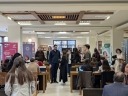
And they needed it, because when the fair kicked off that afternoon, Bissell Library was transformed. Booths lined every corner, organization banners filled the space, and within minutes, students were moving between tables — CVs in hand, making introductions, asking real questions. What’s usually a quiet study space became one of the busiest spots on campus.

entrepreneurship talks

Day 2: Depth and Range

The second day was the fullest. It opened with a panel discussion titled “Bridging Technology and Business,” where professionals from IT consulting, cybersecurity, and talent acquisition sat down together for an open conversation — no slides, no presentations. The format worked. What started as a moderated discussion quickly turned into a genuine back-and-forth between panelists and the audience. Students asked about internships, hiring processes, the gap between university and the workplace, and what skills matter beyond the technical. The panelists stayed well past their scheduled time.

The career fair continued in parallel, and if anything, day two was busier than day one.

Later that afternoon, two more workshops ran simultaneously. Tasos Mitakidis, General Manager at Golden Home Real Estate, led a session on communication and persuasion — practical techniques for building trust, handling objections, and presenting yourself with confidence in any professional setting. At the same time, Ruth Sutton from Wave Thessaloniki led a session on solidarity and volunteering, reminding students that a meaningful career isn’t only about the corporate world. There are paths built around service, humanitarian work, and community impact, and they deserve the same attention.

panel discussions career days 2026

Day 3: The Big Picture

The final day shifted gears entirely. Tommy Baltzis, CFA, CPA — Founder and Chairman at WhiteHaven Asset Management — led a two-hour closing workshop on geopolitics, capital markets, and navigating a world in transition. The session covered macroeconomic trends shaping financial markets, portfolio strategy, risk management, and the future of investing — a reminder that career readiness goes well beyond polished CVs and technical skills. Understanding how the world moves, how global events ripple through industries, matters just as much. It was a fitting way to close three days that had covered everything from interview prep to cybersecurity to humanitarian work to macroeconomics.

tommy baltzis whitehaven

The Aftermath

Perhaps the best measure of an event is what happens after it ends. Within hours, LinkedIn was full of posts from participants — organization representatives sharing photos from their booths, recruiters reflecting on the students they’d met, and professionals calling it “a rewarding experience” and “a fantastic opportunity to exchange ideas and gain insights.” One wrote about how events like this create “a valuable space for collaboration, knowledge-sharing, and forward-thinking discussions.” Another simply said the campus “will always feel like home.”

Screenshot 2026 03 06 at 08.38.27

Screenshot 2026 03 06 at 08.38.58

Screenshot 2026 03 06 at 08.39.04

Screenshot 2026 03 06 at 08.39.12

Screenshot 2026 03 06 at 08.39.27

Screenshot 2026 03 06 at 08.39.34

That kind of response isn’t something you can orchestrate. It happens when the event delivers something real.

What It All Comes Down To

Career Days isn’t a job fair in the traditional sense. It’s not just about handing out CVs and collecting business cards. It’s about contact — the kind that happens when a student sits across from a recruiter and asks a genuine question, or when a panelist shares something honest about their own career that changes how someone in the audience thinks about theirs. It’s a workshop that makes you rethink how you present yourself. It’s a session on volunteering that opens a door you hadn’t considered.

Thirty-plus organizations showed up. Hundreds of students walked through the doors. And for three days, the distance between classroom and career got a little shorter.

Already looking forward to next year.

career days 2026 wrapup


More

Costas Georgiades '96, BSc in Business Administration

Costas joined the American College of Thessaloniki (ACT) in 1992 and graduated in 1996 with a BSc in Business Administration. His professional journey began in retail as a Marketing Manager, before moving into pharmaceutical distribution as an Export Manager and later as a General Manager.

In 2006, he took the step into entrepreneurship, establishing and leading companies in Greece, the UK, Bulgaria, Sweden, and the Netherlands. All of them operate in pharmaceutical distribution, focusing on niche markets and creating value through international collaboration and strategic growth.

The best memory I have of ACT…

ACT gave me countless memories, both academic and personal. What stands out most is the strong friendships built during those years, friendships that have stood the test of time and remain an important part of my life today.

My favorite professor was…

Panos Vlachos, without hesitation. Mathematics was my favorite course, and his passion and clarity in teaching made it truly inspiring.

My favorite spot on campus was…

the basketball courts. They were more than just a place for sports, they were a place of teamwork, competition, and connection. I spent endless hours there.

ACT helped me …

Studying at ACT was transformative. It gave me not only a solid academic foundation but also the confidence to think independently and act decisively. The combination of a liberal arts education and a practical, real-world approach shaped the way I analyze complex environments and make strategic decisions. ACT’s international culture prepared me to collaborate across borders and lead in diverse settings.

The elements that characterize the identity of ACT graduates are…

ACT graduates combine a global mindset with strong analytical thinking, adaptability, and integrity. They are prepared to navigate complexity, embrace diversity, and pursue excellence with responsibility.

For me ACT is…

For me, ACT is a lifelong community. It is the place where my ambitions took shape, where I built lasting relationships, and where I developed the mindset that continues to guide my professional and personal decisions.

The best part of my job is…

building teams that create growth with meaningful impact. One defining moment was when we managed to source and deliver a life-saving medicine to a remote location where others could not. Knowing that our work directly affects lives is the greatest motivation.

I consider this an important moment in my professional journey…

A pivotal moment was my decision in 2006 to expand beyond Greece and establish my first company in London, UK. That step transformed my professional horizon, opening the door to international markets, strategic partnerships, and new opportunities that continue to shape my path.

In the future, I want to…

continue learning, expanding my vision, and building organizations that create sustainable growth and meaningful impact across borders.

More

From Classroom to Live Studio: Journalism Students Go Behind the Scenes at ERT3

On Friday, December 5, 2025, students from ACT’s Communication & New Media program stepped out of the classroom and into the fast-paced world of broadcast journalism during an educational visit to the ERT3 television studios in Thessaloniki.

Coordinated by Dr. Eva Malinaki, Assistant Professor at ACT, the visit was designed for students in COMM 233 – Introduction to Journalism, offering a rare, hands-on look at how news and live programming are produced; moment by moment, under real-time pressure.

During the tour, students engaged in conversations with journalists, producers, and technical staff, gaining insight into the distinct roles that come together behind the camera: editorial decision-making, studio coordination, sound and lighting, directing, and the split-second teamwork required to keep a broadcast on track.

visit to ert3 1

visit to ert3 2

The highlight came when students participated live on ERT3’s morning show, “Mera me Chroma”, a daily magazine-style program that blends information and culture, with a focus on topics such as society, science, the environment, innovation, and entrepreneurship. Experiencing a live set from the inside transformed “how TV works” from a concept into a lived reality: one that made the craft, ethics, and responsibility of journalism feel immediate and tangible.

This kind of faculty-led, experiential learning reflects ACT’s commitment to teaching that goes beyond the expected: creating opportunities where students don’t just study media, they practice it, guided by educators who actively open doors to the industry.

Read the official news coverage by ERT3 here (information in Greek).

visit to ert3 5

More

SNCH 115 Fall 2025 Students Explore Interdisciplinary Science at CIRI AUTh

Students from the Anatomy and Physiology course (SNCH 115) conducted a highly successful, research-oriented field visit to the Center of Interdisciplinary Research and Innovation (CIRI) at the Aristotle University of Thessaloniki (AUTh) in November 2025. This enriching experience provided students with direct exposure to state-of-the-art scientific research.

The visit commenced with a comprehensive presentation on CIRI AUTh and its core mission, delivered by Department Manager Mrs. Andreadou. Following the introduction, students were divided into three groups and rotated through the following three cutting-edge laboratories:

a. Laboratory of Neurodegenerative Diseases (LND): Coordinated by Professor Magda Tsolaki (Emeritus Professor of Neurology, Faculty of Medicine, AUTh).

b. FunPAth and GENeTres Laboratories: Coordinated by Professor Michalis Aivaliotis and Professor Georgios Tzimagiorgis (both Professors of Biochemistry, Faculty of Medicine, AUTh).

c. Magna-Charta Laboratory: Coordinated by Professor Makis Angelakeris (Professor of Physics, Faculty of Physics, AUTh).

The primary goal of the visit was to connect students with active research departments in Thessaloniki and offer valuable insight into ongoing, high-impact research projects, including those funded through prestigious Horizon Europe programs. Through direct interaction with leading researchers, students gained invaluable exposure to interdisciplinary approaches in biomedical and applied sciences, helping to illuminate potential future career paths in these dynamic fields. 

More

Microbiology Students Gain Real-World Insights into Quality Assurance at Local Production Facility

Students enrolled in the Microbiology and Infectious Diseases Spring II 2025 course recently participated in an insightful site visit to a major local meat-production industry. This practical experience offered students a firsthand look at the critical importance of quality assurance in the food industry.

During the visit, students observed the entire production process, from the handling of raw materials to the packaging of the final product. A key highlight was the engaging discussion with the department manager, who provided valuable, market-relevant insights and fielded questions from the students. This opportunity underscored microbiology's crucial role in maintaining food safety and quality, demonstrating for students how classroom theory directly translates into practical industry relevance.

More

Ecology Students Transform Urban Parks into Living Laboratories

The Fall 2025 Ecology curriculum is bridging the gap between classroom theory and real-world application through innovative, field-based instruction conducted within the urban park environments of the Thessaloniki center. Students actively engaged with core ecological principles through direct, empirical observation, turning local green spaces into accessible, outdoor laboratories.

Ecology 2

This hands-on approach involved systematically recording local biodiversity and conducting detailed assessments of anthropogenic impacts, the effects of human activity, within these shared urban spaces. By doing so, students gained a practical, first-hand understanding of ecosystem functionality and resilience within an urban framework. This initiative not only enhanced scientific literacy, but also contributed valuable observational data on the health of our local environment. 

Ecology 3

More

Students Uncover Microbial Secrets of Lake Kerkini with Cutting-Edge DNA Sequencing

A field research trip by students from ACT - The American College of Thessaloniki to the ecologically rich Lake Kerkini in October has yielded fascinating and significant results, confirming the highly dynamic nature of microbial communities within this important aquatic environment.

The student research team successfully executed a comprehensive workflow, beginning with the collection of water samples from diverse points around the lake. Upon returning to the laboratory, they conducted a cutting-edge metagenomic analysis of the resident bacterial populations. The team utilized the portable and powerful MinION sequencing platform (Oxford Nanopore Ltd) to sequence the DNA extracted from the environmental samples.

kerkini field trip 2

kerkini field trip 3

Crucially, the subsequent data analysis revealed distinct differences in the species diversity and the relative abundance of bacteria when comparing samples taken from various locations along the shoreline. These variations strongly underscored how localized environmental factors, such as nutrient runoff from surrounding land, sediment concentration, and the degree of light penetration, profoundly influence and shape the microbial ecosystem at different points of the lake.

The successful application of this entire process, from hands-on field collection to employing sophisticated sequencing technology and performing complex data analysis, generated results of high scientific value. This achievement has significantly fueled the students' enthusiasm for the fields of microbial ecology and environmental genomics, highlighting ACT's commitment to providing students with practical, high-impact research experience. 

kerkini field trip group

More

Activity

By

The Dukakis Center hosts public programming and applied initiatives that connect academic insight with civic life. Across all activity, the common thread is a commitment to inspiring youth to take active roles in public affairs, while inviting the wider community into informed, constructive dialogue. Our work is broad in format, but consistent in purpose: to create spaces where complex public questions can be examined with seriousness, context, and civic responsibility.

Public events and open forums

Each year, the Center convenes public events on issues that shape contemporary public life. Core themes include foreign policy and diplomacy, international, local, and corporate governance, historical remembrance and creative expression, and lifelong education. Programming is designed to be accessible without being simplistic, and to support civic literacy by bringing together academic perspectives and real-world experience.

Event formats: lectures, seminars, roundtables, public readings, and masterclasses. These are hosted both on campus and, when appropriate, at venues beyond campus in Thessaloniki, Athens, and elsewhere.

Selected past guests include:

  • Historians: Mark Mazower, Jeffrey Engel 
  • Classicists: Angelos Chaniotis, Jenifer Neils
  • Political Scientists: Charles Stewart III 
  • Diplomats: Nicholas Burns, Álvaro de Soto
  • Journalists: Stephen Grey, Landon Thomas
  • Former intelligence officers and security experts: John Kiriakou, Alan Makovsky
  • Foresight experts: Epaminondas Christofilopoulos

Seminar series and youth-focused engagement

Never losing sight of its core mission to engage youth, the Center hosts a regular seminar series that brings younger scholars and non-academic specialists into close conversation with students. These formats tend to be more interactive and skills-oriented than large public lectures, and they aim to help young people build both substance and confidence: how to ask better questions, how to evaluate arguments, and how to connect academic learning with civic participation.

Skills-building and professional capacity development

In addition to public dialogue, the Center supports practical capacity-building that strengthens participants’ readiness to engage the public sphere. This includes specialized training in report writing and research skills, developed in collaboration with the Career Services Office at ACT. When relevant to an initiative, the Center also contributes to structured workshops and applied sessions that translate civic interest into usable professional competencies.

Politis and public conversation in digital formats

The Center extends civic dialogue beyond the room through public-facing communication and media engagement. Staff provide occasional commentary on Greek television and radio and in select print media. The Center has also established Politis: The Voice of the Dukakis Center, its blog on contemporary citizenship, and maintains an active presence across social media. Together, these channels help sustain an ongoing public conversation around civic values, democratic life, and responsible participation.

Entrepreneurship and the Business and Politics Forum

The Dukakis Center maintains strong interest in entrepreneurship at the local and national levels across business, civil society, and the public sector. A flagship convening in this area is the Business and Politics Forum, organized every other year. The Forum brings together leading practitioners from the private and public sectors to examine a theme of interest to the business and policy communities of Northern Greece. It is designed to encourage candid, practical exchange at the intersection of institutions, markets, and civic responsibility.

Geopolitics, defense, and security studies

Given the chronically turbulent dynamics in Eastern and Southeastern Europe and the Eastern Mediterranean, the Center is committed to organizing events and promoting research related to geopolitics, defense, and security studies. In its role as an issue-centric think tank, the Center also supports interdisciplinary communication among intellectuals, policy practitioners, and the wider public on questions of regional, national, and international security. This work is expressed through focused public discussions, expert-led sessions, and research-oriented initiatives that bring multiple perspectives into contact.

-

Interested in attending an event, proposing a theme, or exploring collaboration? The Dukakis Center welcomes inquiries from institutions, practitioners, alumni, and students aligned with its mission.

More

Dukakis Center hosts book presentation on the Greek image of the United States

The Dukakis Center hosted its final event of the 2025 calendar year on Friday, December 19, with a stirring presentation of The Greek Vision of the United States of America, from the Greek Revolution to World War I (Το όραμα των Ελλήνων για τις Ηνωμένες Πολιτείες της Αμερικής), by Kostas Diogos, an independent scholar based in Serres.
 
A star-studded panel of scholars offered their impressions on Dr. Diogos’ book, the text of which is an abridged and edited version of his doctoral dissertation at Aristotle University of Thessaloniki. George Kalogeras, Nikos Marantzidis, and Anatolia University’s own Christos Aliprantis all took turns offering commentary on the merits of the book. The panel was moderated by Professor Basil Gounaris, who had served as Dr. Diogos’ Ph.D. advisor. 
 
The event was co-sponsored by the Foundation of the Museum of the Macedonian Struggle and Alexandreia Publishers, with the participation of AHEPA Hellas, and the YMCA of Thessaloniki. The event was notable insofar as Dr. Aliprantis featured as a peer of his colleagues from Aristotle University and the University of Macedonia.
 
David WIsner, the founding Director of the Dukakis Center, opened the proceedings with a brief overview of the Dukakis Center’s 25 years, and, in keeping with the theme of Kostas Diogos’ book, a portrayal of the America which has been represented by the scores of expatriate Americans who have distinguished themselves in service of Anatolia College since its establishment. 
 
Professor Wisner paid tribute in passing to former Anatolia Presidents William McGrew and Richard Jackson, who had played fundamental roles in the early days of the Dukakis Center. Wisner also noted that Kostas Diogos embodied the Center’s ethos of public service perfectly, in his dedication to extracurricular teaching and independent scholarship.
 
The Michael and Kitty Dukakis Center for Public and Humanitarian Service was launched in September 1999 to celebrate the accomplishments and public service ethos of three-term Massachusetts Governor Michael Dukakis, the 1988 Democratic Presidential Nominee. Since its inception, the mission of the Center has been to inspire young citizens from Greece and the United States to take an active interest in public affairs. 
 
Under the direction of Professor Wisner, the Dukakis Center has organized and/or hosted nearly 300 public events in Thessaloniki, Athens, and further afield. The Center celebrated its Silver Jubilee season of public service initiatives in 2024-25.
 
 
0016
0069
0095
0115
008
0085
003
More

History and International Relations at the Dukakis Center

There is a photograph of the fundraising gala held in Boston in honor of former Massachusetts Governor Michael Dukakis by the Trustees of Anatolia College in 1998. It was a black tie event, and by all accounts a successful evening. A sizable sum was raised, forming the core of what became known as the Dukakis Endowment.

In the center of the photograph in question then-President WIlliam McGrew stands next to Michael and Kitty Dukakis. One suspects the event was scheduled to coincide with the annual autumn trustees meeting in Boston. The other guests in the photograph are trustees and their spouses.

The pairing of William McGrew and Michael Dukakis was highly symbolic. One of the objectives of the creation of an endowed chair bearing the name of the 1988 Democratic Nominee for President of the United States was to enhance the recently formed undergraduate major program in history and international relations. McGrew was by training a Ph.D. historian who had served in the US Foreign Service for a short time before taking up the reins at Anatolia in 1974. History and diplomacy were here represented side by side with politics and public policy, embodied by Dukakis. (In tribute to Kitty Dukakis, a humanitarian dimension would be added to the equation formally in 2011.) These fields of study would be united under the banner of public service, a value which had animated Anatolia College since its foundation in Asia Minor in the late nineteenth century.

For sure, ACT had hosted prominent historians like WIlliam McNeil and Lord Asa Briggs before Michael and Kitty Dukakis first visited Anatolia in September 1999. It is also true that many of the events and activities organized under the auspices of the Dukakis Chair and Center celebrated other academic domains. (William McGrew’s successor, retired foreign service officer Richard Jackson, studied English literature as an undergraduate at Princeton.) Nonetheless, countless events hosted between 2000 and 2025 have focused on history and politics, or, as we then called it, history and international relations.

The Dukakis Center has hosted diplomats and historians and public figures since the very beginning. The record is impressive. By the end of our third full year we had hosted Mark Mazower, Van Coufoudakis, Victor Davis Hanson, Thea Halo, Stephen Whitfield, and Barbara Harrell-Bond. Those whose work or works have subsequently been feted include Heath Lowry, Brady Kiesling, Jenifer Neils, Yannis Stefanidis, Evangelos Kofos, Marilyn Yalom, Rena Molho, Angelos Chaniotis, Harris Mylonas, Thanos Veremis, Jeffrey Engel, Mary Beth Norton, and, why not, George Toulas. (One could never, alas, persuade ACT’s own Joseph Michael Gratale to put in an appearance.)

The Dukakis Center has always sought to maintain a healthy balance between scholarship and practice, hence some of the names on the list. The same has applied to those invited to discuss international relations with our audiences. Nikiforos Diamandouros, who spoke on two distinct occasions at Dukakis Center events, represents this balancing act perfectly.

It is fitting, then, that the final event of the silver jubilee celebration coming to a close this month at the Dukakis Center should be the presentation of a splendid new book by the Serres-based historian Kostas Diogos. One might think of this event as a coda of sorts to the vision outgoing Executive Director -- and fellow historian -- David Wisner has had of the Center, a public meditation on education and service and their role in promoting friendship and cooperation between the peoples of the United States and the Hellenic Republic.

The jury may still be out on the impact the Dukakis Center has had since September 1999, but the next chapter of our history is ready to be written.

More
 

17 Sevenidi St.
55535, Pylaia
Thessaloniki, Greece
Tel. +30 2310 398398
P.O.Box 21021
Email: This email address is being protected from spambots. You need JavaScript enabled to view it.